
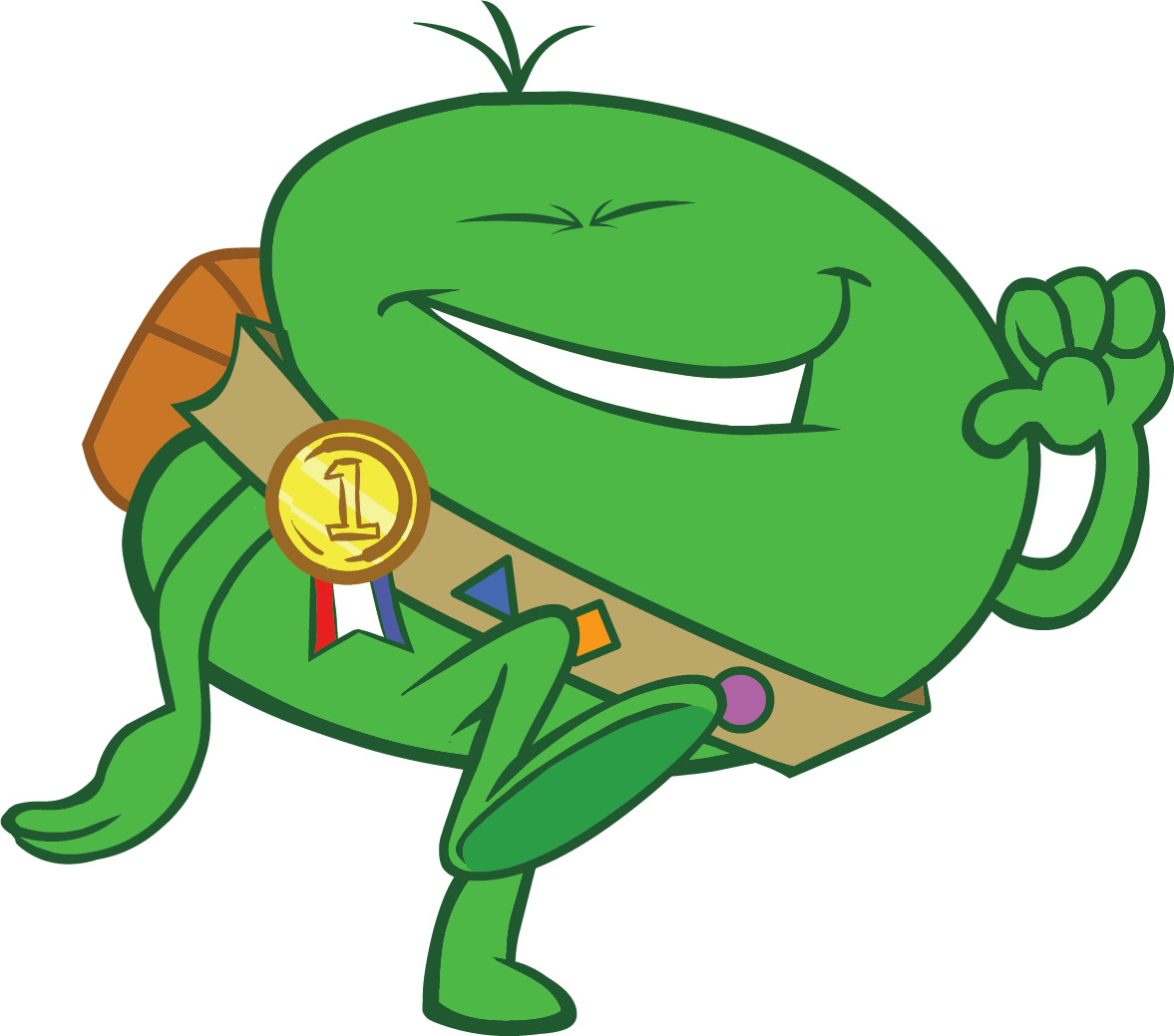
Jake the Adjective
An adjective describes a noun or pronoun. It tells what kind, which one, how many, or how much.
Part of a Grammaropolis membership.
Parents: find your child's starting point. It's about ten quick questions, free, and no account needed.
Teachers: see the classroom route. It's free, rostering is included, and it's standards-aligned across four frameworks.
"Without me, love, your world is dull and gray."

No score, no sign-in. Tap to answer, then see the standard it hits. Change the grade above to watch the same idea deepen.
Two or three? Pick the word that fits. Benny calls the superlative, Angelica calls the comparative, and the scene acts out whichever word you pick.
Taller, Tallest →An adjective describes a noun or pronoun. It tells what kind, which one, how many, or how much.
Jake teaches the same idea across every grade, starting simple and going deep. Here is the whole concept: what it does, the jobs and kinds it splits into, the mistakes to watch for, and a worked example for each.
At Grade 3, Jake adds Demonstrative Adjectives, Possessive Adjectives, Interrogative Adjectives, Comparative Adjectives, and Superlative Adjectives to what he already teaches.
Nelson names the thing: a coat. Jake describes it: a bright, woolen coat. He tells what kind, which one, how many, or how much. Without Nelson, Jake has nothing to color.
Meet Nelson.
Word, then the character who embodies it, then its part of speech.
An adjective is a word that describes or modifies a noun. Adjectives tell about color (blue, red), size (big, small), shape (round, square), taste (sweet, sour), texture (soft, rough), quality (beautiful, wonderful), or number (three, many).
- "The big dog wore a blue collar and ate sweet treats."
- "Three wonderful students had happy faces."
- "She bought a red apple and a beautiful dress."
- Confusing adjectives with adverbs
- Forgetting that numbers are adjectives
- Overlooking subtle descriptive adjectives in sentences
Adjectives can come before a noun (the playful children) or after a linking verb (the children seem playful). When two or more adjectives describe a noun equally (you could put and between them), separate them with commas (the cheerful, playful children).
- "The playful children ran around while the children seemed playful."
- "The big, red barn stood on the hill near a small, white house."
- "Those sweet, juicy oranges taste delicious."
- Forgetting commas between multiple adjectives
- Placing adjectives after nouns when they should come before
- Using too many adjectives without proper punctuation
Demonstrative adjectives (this, that, these, those) point to specific nouns. Possessive adjectives (my, your, his, her, its, our, their) show ownership. Interrogative adjectives (which, what, whose) ask questions.
- "This picture and that one look similar; which shirt do you like?"
- "My friend forgot her homework and whose backpack is this?"
- "That teacher recommended this book and what color do you prefer?"
- Confusing possessive adjectives with possessive pronouns (your vs. yours)
- Using wrong demonstrative forms (this/that with plural nouns)
- Forgetting to treat interrogative words as adjectives when they modify nouns
Comparative adjectives compare two things. For short adjectives (1-2 syllables), add -er (taller). For longer adjectives (3+ syllables), use more (more beautiful). Superlative adjectives compare three or more things. For short adjectives, add -est. For longer, use most. Irregular forms: good/better/best, bad/worse/worst.
- "Sarah is taller than Emma but Mount Everest is the tallest mountain."
- "This book is more interesting than that one and that's the most beautiful sunset."
- "The blue car is fast, the red car is faster, and the black car is the fastest of all."
- Using -er and more together (more taller is wrong)
- Forgetting to add -er/-est to short adjectives
- Using wrong forms for irregular adjectives like good (not gooder) and bad (not bader)
Why families and teachers trust Grammaropolis.
"Learning grammar has never been more fun!"
"Like Grammar Rock and the Mr. Men books had an adorable love child."
"My students even asked if they can get extra credit for making up a dance or new lyrics to the songs."
"After using it last year, my kids really got it!"
When a child finishes a cycle, the Mayor signs a certificate naming exactly what they learned. Proof of learning, not a score, and standards-aligned across Common Core, Texas, Florida, and New York.
Wherever Grammaropolis lives.






Ready to learn adjectives with Jake?
Learn adjectives →Nelson's lessons are always free for every grade. The rest is part of a Grammaropolis membership.