
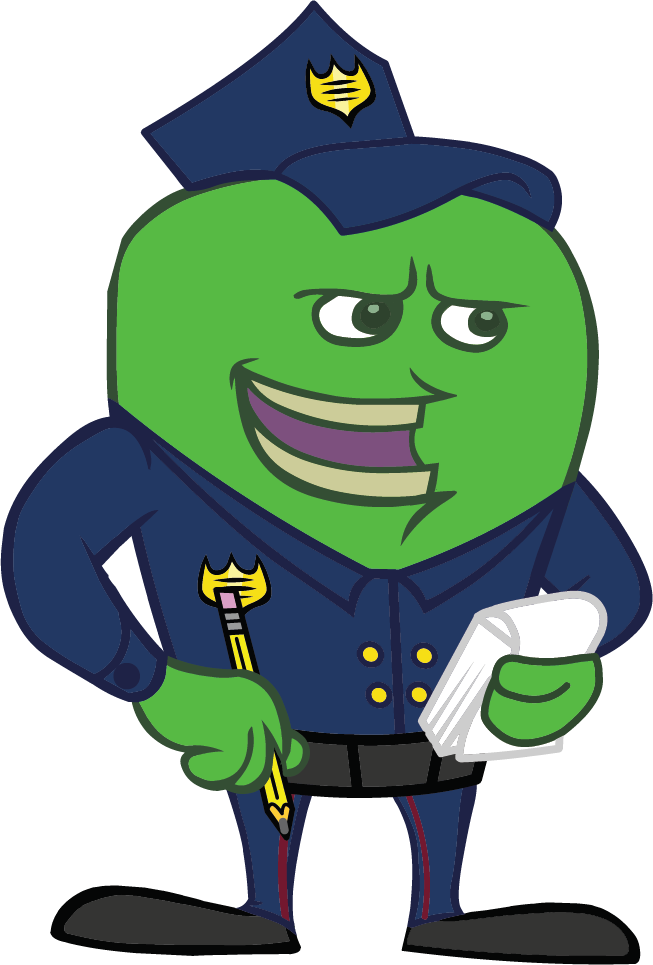
Li'l Pete the Preposition
A preposition shows the relationship between a noun or a pronoun and other words in the sentence. It locates its object in space or time, or shows a logical relationship.
Part of a Grammaropolis membership.
Parents: find your child's starting point. It's about ten quick questions, free, and no account needed.
Teachers: see the classroom route. It's free, rostering is included, and it's standards-aligned across four frameworks.
"I'm pre-positioned for greatness."

No score, no sign-in. Tap to answer, then see the standard it hits. Change the grade above to watch the same idea deepen.
Catch the falling words, sort each to the right character, and watch them build a real sentence.
Grammar Drop →A preposition shows the relationship between a noun or a pronoun and other words in the sentence. It locates its object in space or time, or shows a logical relationship.
Li'l Pete teaches the same idea across every grade, starting simple and going deep. Here is the whole concept: what it does, the jobs and kinds it splits into, the mistakes to watch for, and a worked example for each.
At Grade 3, Li'l Pete adds Compound Prepositions to what he already teaches.
Li'l Pete relates one thing to another: the cat slept under the table. Take away his object and he is not a preposition at all: the cat slept under. Li'l Pete needs his object to do his job.
Meet Nelson.
Word, then the character who embodies it, then its part of speech.
A preposition shows the relationship between an object (noun or pronoun) and other words in the sentence. Prepositions can be single words (in, on, at, under) or compound prepositions (next to, because of, instead of). Prepositions localize objects in space (WHERE), time (WHEN), or show logical relationships.
- "Meet me next to the stop sign down the street."
- "I will do my homework after dinner on Sunday."
- "The game was canceled because of the rain."
- Confusing prepositions with adverbs (around as prep vs. around as adverb)
- Forgetting that prepositions always have objects
- Using wrong preposition for the intended meaning
A prepositional phrase starts with a preposition and ends with the object of the preposition. The structure is: PREPOSITION + OBJECT. Examples: next to the couch, outside the teachers' lounge, at the exact time, in my wallet, with the blue collar.
- "Jana came home at the exact time I was leaving."
- "I never drink hot cocoa without marshmallows."
- "Charlie fell asleep in his brand new purple bed."
- Separating the preposition from its object
- Confusing prepositional phrases with independent clauses
- Forgetting to identify the complete phrase
A compound preposition is more than one word but acts as a single preposition. Common compound prepositions include: next to, instead of, because of, due to, according to, ahead of, apart from, in front of, out of.
- "Due to my bad memory I forgot that guy's name."
- "She sat next to her best friend; according to the rules, this was allowed."
- "Instead of running, they walked in front of the building."
- Treating parts of compound prepositions as separate words
- Using wrong compound preposition for context
- Separating parts of compound prepositions in sentences
Some words function as both prepositions and adverbs: around, up, down, outside, over, in, out, through, above, below, before, after. Test: If there's an object after the word, it's a preposition. If the word stands alone, it's an adverb.
- "We ran around the field (preposition) but we ran around (adverb)."
- "The cat ran up the tree (up = preposition, with the object 'the tree'). The balloon floated up (up = adverb, with no object)."
- "Look outside the window (preposition) or go outside (adverb)."
- Failing to identify the object of the preposition
- Treating all instances of a word the same way
- Confusing adverbial use with prepositional use
Why families and teachers trust Grammaropolis.
"Learning grammar has never been more fun!"
"Like Grammar Rock and the Mr. Men books had an adorable love child."
"My students even asked if they can get extra credit for making up a dance or new lyrics to the songs."
"After using it last year, my kids really got it!"
When a child finishes a cycle, the Mayor signs a certificate naming exactly what they learned. Proof of learning, not a score, and standards-aligned across Common Core, Texas, Florida, and New York.
Wherever Grammaropolis lives.






Ready to learn prepositions with Li'l Pete?
Learn prepositions →Nelson's lessons are always free for every grade. The rest is part of a Grammaropolis membership.